
Saving money can sound like an overwhelming and intimidating task especially when the goal is as big as $30,000 which is why it is necessary to break it down into smaller and more manageable chunks. This idea behind the 52 week challenge is to start small and gradually build your savings over time. Over time, these small yet consistent efforts can turn into a significant amount, making every deposit worth it. Whether your goal is to build an emergency fund, save for a big future purchase, or simply take control of your finances, this challenge can be your to go for saving a big amount. This article will help you explore the dynamics of the 52 weeks challenge, ensuring that it goes smoothly.
Set Your Target and Timeline (Week 1)
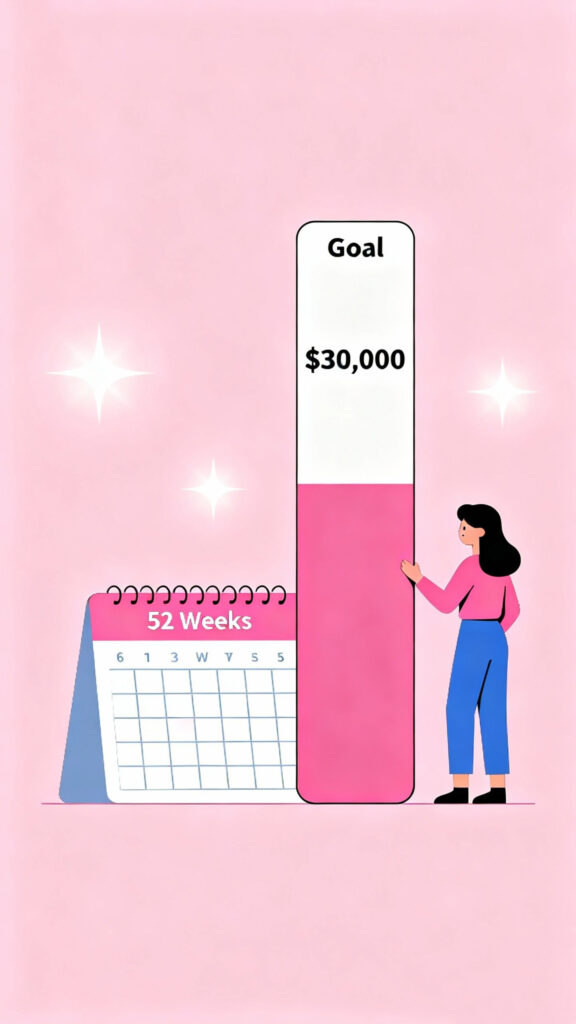
Before starting your savings journey, you need to set your goal clearly which in this case is $30,000 in 52 weeks. You can divide your total goal by 52 and get an average of around $577 per week. While this may sound high, you need to convert this big overwhelming goal into small pieces for the challenge to sound less intimidating.
The key is to commit to the challenge from day one and follow it with consistency. Over time, these consistent efforts will turn into something big and meaningful, making your decision to begin with the challenge and every tiny deposit worth it.
Create a Dedicated Savings Account (Week 1)
One of the best ways to stay consistent with the savings challenge and make sure that you deposit an amount every week is to create a dedicated savings account separate from your regular money. Having a separate account can prevent you dipping into your savings whenever the urge to spend arises, making it necessary to have one.
You can label the account with something motivating like, “My Savings Journey” or “My $30K Goal”. This psychological trick helps remind you why you started the journey in the first place, helping you find the challenge motivating and rewarding.
Start Small and Build Gradually (Weeks 1–4)
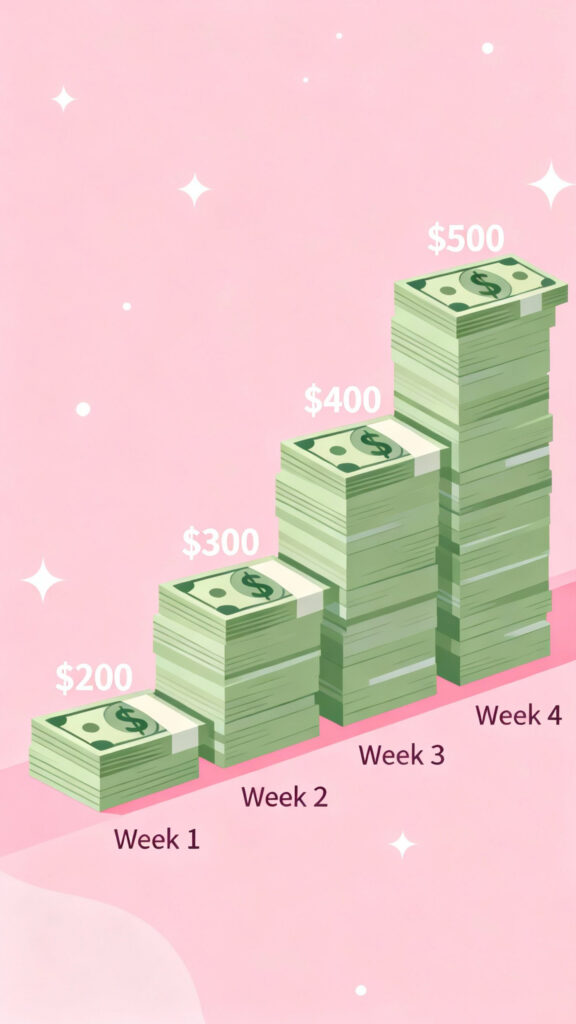
The next step is to begin with the challenge and build habits that will help you stay consistent with it, not focusing only on the numbers. You can start small to get comfortable in the initial phases of the challenge, for example, in the first week, you can save around $200, $300 in week 2, $400 in week 3, and $500 in week 4. This way, by the end of the month you’ll have around $1,400 saved, which is a pretty good figure for the initial phases.
Starting small can help you get used to the challenge and once you see what these deposits add up to, it can strengthen your motivation to keep moving forward.
Adjust Your Lifestyle and Cut Back (Weeks 5–8)
As you move into the second month of your 12 month challenge, it’s time to go through your spending habits and make modifications to your spending choices. You can consider those seemingly small leaks or those areas of weakness that quietly eat away your income, whether it’s dining out frequently, grabbing coffee every morning, or subscribing to services you barely use.
For these weeks, try saving between $550-$600 weekly, and your total can reach around $4,000-$5,000. The main catch of this stage is to adjust your lifestyle according to what matters the most to your finances at the moment, which is your savings challenge
Automate Your Savings (Weeks 9–12)
The next step in your 52 week challenge is to make the process of setting money aside effortless and low maintenance by automating your savings. Choose a specific day for the transfer, ideally, it should be your payday, because this hack takes away the possibility of you dipping into your income when you receive your paycheck, also known as “paying yourself first”.
During these 9-12 weeks, try to save around $600 weekly, and by the end of week 12, you’ll have around $7,000 saved.
Use Extra Income to Boost Your Progress (Weeks 13–20)
The next step in your 52 week journey is to earn extra income to boost your progress. Relying solely on a single income in today’s economy can be hard, especially when you’re working on a savings challenge as well. You can work as a freelancer and advertise your services through freelancing platforms such as Fiverr, Upwork, or freelancer.com. Moreover, you can offer babysitting or pet sitting services and even consider selling unused items in your home.
During these 13-20 weeks, keep saving $650-$700 each week and by the end of the 20th week, you’ll have around $12,000 to $13,000 saved.
Stay Motivated and Track Your Growth (Weeks 21–28)
The next important step when you move on with the savings challenge is to remind yourself that it’s completely okay if the challenge loses its spark, what matters the most is that you stay committed and consistent to the goal you started for in the first place. You can create a visual tracker like a chart, a savings thermometer, or even a notebook to record your progress. Seeing your savings can be a great motivation and confidence booster that ensures you move on with the challenge even through the boring and dull phases.
During these 21-28 weeks, save $700-$750 weekly so that by the end of the 28th week, you can save around a total of $17,000
Revisit and Readjust Your Budget (Weeks 29–36)
Around this time of the challenge, it’s very likely that your financial circumstances might have taken a shift, whether you paid off a debt, earned a raise, or managed to cut more expenses. Utilize this period to review your budget and adjust your savings target if possible. Even adding an extra $50–$100 per week can make a noticeable difference and you’ll be surprised by how your mindset has evolved in these few weeks. By the end of the 36th week, make sure you have saved a total of $22,000.
Stay Strong Through the Slower Weeks (Weeks 37–44)
As you move further along in your savings journey, it’s completely normal to experience moments where you feel tired, unmotivated, or even tempted to give up. You can look back at the sacrifices you’ve made and the amount you’ve already saved to reignite your motivation.
By continuing to save around $750–$800 weekly during these weeks, you’ll find yourself getting closer and closer to your $30,000 goal, and that thought alone can push you forward with renewed energy and determination.
Make a Final Push (Weeks 45–50)
At this point, you’re nearing the finish line of your 52-week challenge, and these last few weeks are all about giving that final push of effort and energy. This is a great time to look for small but effective ways to increase your income or reduce expenses, whether that’s selling things you no longer use, skipping a few takeouts, or finding small freelance or side hustle opportunities to earn a little extra.
You can aim to save $800–$900 weekly during this phase, and every extra deposit will bring you one step closer to completing what once seemed like an impossible goal.
Reach Your $30,000 Goal (Weeks 51–52)
By the final two weeks of your challenge, you’ll finally reach the most rewarding part that is seeing your hard work, patience, and persistence turn into something meaningful. Hitting your $30,000 goal is more than just a financial win, it reflects your growth and your ability to stay consistent.
Take a moment to look back at the entire journey, from your first $200 deposit to this incredible achievement, and appreciate every bit of effort you put in.
Plan What Comes Next
Now that you’ve completed your savings challenge and have $30,000 in your account, it’s time to decide how to use it wisely and purposefully. You can divide your savings into different categories based on your priorities, for example, setting aside a portion for an emergency fund, investing in something long-term, or saving for a future goal like a home, travel, or education.
The most important thing is to make sure your money works for you instead of being spent impulsively.
Conclusion
The 30,000 Money Saving Challenge is much more than just a plan to save a certain amount of money, it’s a full-year journey of discipline and transformation. Throughout these 52 weeks, you can learn that saving isn’t just about perfection or high income, it’s more about those small and consistent efforts that build up over time. By the end of the challenge, you don’t just walk away with $30,000 sitting in your savings account, you also carry with you a sense of control, confidence, and empowerment that changes how you view money altogether. This challenge proves that even the biggest goals can be achieved when you break them down into simple, consistent steps and believe in the power of persistence.