
Unlock the Editor’s Digest for free
Roula Khalaf, Editor of the FT, selects her favourite stories in this weekly newsletter.
Fear gripped much of Lebanon’s capital after the Israeli military issued a sweeping evacuation order for all of southern Beirut, which is home to hundreds of thousands of people.
Thousands of people began fleeing, causing gridlock on the roads following Thursday’s order, which was Israel’s most extensive for Beirut in the current war and bigger than any it issued during the 2024 conflict with Hizbollah.
It came a day after a sweeping evacuation order for southern Lebanon, where Hizbollah draws much of its support, covering about 8 per cent of the country’s land area.
The war in Lebanon has escalated sharply in the four days since Hizbollah fired rockets into Israel on behalf of Iran, triggering a brutal offensive by Israel.
Israeli military spokespeople published warnings on X on Thursday afternoon with a map marking whole neighbourhoods of southern Beirut in orange and red. They ordered all residents to leave to “save your lives”, sparking terror across swaths of the city. Previous evacuation orders in the capital had marked specific buildings that would be targeted.
Thursday’s order told residents to head either “east towards Mount Lebanon on the Beirut-Damascus road”, or “north towards Tripoli on the Beirut-Tripoli road”, leaving many unsure where to go.
Lebanese President Joseph Aoun on Thursday evening asked French President Emmanuel Macron to intervene to prevent the targeting of Beirut’s southern suburbs and called on him to work to stop the fighting as quickly as possible.
Hania Zein, 44, a resident of the southern city of Tyre, evacuated her family of 12 to Beirut on Wednesday following Israel’s unprecedented mass evacuation orders of Lebanon’s south.
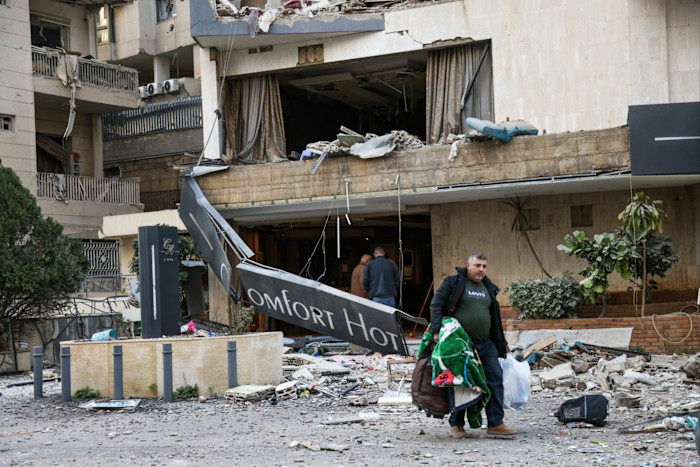
She sought refuge with relatives in Beirut’s southern suburbs overnight, “where we were 44 people in a three-bedroom apartment”. By Thursday afternoon, she was forced to move again.
“We may as well stay in the streets because Israel is going to strike us all, wherever we go,” she told the FT, sobbing. “I can’t take it any more.”
Another resident of the southern suburbs said her family was choosing to remain for the time being because the chaos in the neighborhood and on the roads meant it would be impossible to reach a safer area in time.
While official numbers are hard to come by, given that there is no census in Lebanon, the head of Southern Beirut’s union of municipalities, Mohammad Durgham, said the area of the capital affected by the evacuation orders was home to about 850,000 people.
Durgham spoke to the FT from a traffic jam as he, along with thousands of others, was trying to flee the area.
Beirut’s southern suburbs are diverse and lively residential districts where Hizbollah holds sway. The area affected by the order is also home to government buildings including the presidential palace, ministry of labour and ministry of health as well as numerous major hospitals.
Durgham said the hospitals in the area remained open as of early Thursday evening, adding that they should be protected under international law.
Following the evacuation order, Bezalel Smotrich, Israel’s far-right finance minister, threatened to turn Beirut’s southern suburbs “into Khan Younis”, referring to a city in southern Gaza devastated by the Israeli military during the war that followed Hamas’s October 7, 2023 attack on Israel.
Beirut’s southern suburbs have hosted waves of internal migration over Lebanon’s history of conflict — most recently from the country’s south in the last war with Israel in 2024. Since then, tens of thousands of people had remained unable to return to the devastated south of the country.
“This first night is going to be a very hard night for people, for the families,” Durgham said.
The Israeli military has carried out widespread strikes on Beirut’s southern suburbs and Lebanon’s south and east this week, while Hizbollah says its fighters have clashed on the ground with Israeli troops advancing into southern Lebanon.
Israeli strikes in Lebanon have so far killed 102 and wounded 638 people, according to Lebanese health authorities.
Cartography by Steven Bernard