
The stock market currently stands at historically elevated levels. With only a handful of companies accounting for an outsize share of the S&P 500‘s (^GSPC +0.21%) total valuation, this concentration creates genuine risk.
Widespread enthusiasm surrounding artificial intelligence (AI) and adjacent markets has so far been enough for investors to shrug off any perceived macroeconomic weakness. While this resilience is impressive, every bull market eventually faces a moment when the music stops. The question smart investors are asking is straightforward: What should one do when a bear market arrives?
Image source: Getty Images.
Understanding the CAPE ratio
The cyclically adjusted price-to-earnings (CAPE) ratio measures the market’s current price relative to the average inflation-adjusted earnings over the past 10 years. By smoothing earnings across different economic cycles, the CAPE ratio better filters out the fleeting spikes and troughs that can distort ordinary price-to-earnings (P/E) snapshots.
A rising CAPE ratio means investors are paying incrementally more per dollar of earnings. That willingness usually reflects optimism about future growth, yet it subtly also compresses the margin of safety. In other words, when the CAPE ratio climbs meaningfully above its long-term average, the market is effectively pricing in perfection.
Analyzing prior CAPE readings
Today’s CAPE reading of 41 is the highest since the late-1990s dot-com bubble peak. In fact, the CAPE ratio now sits within striking distance of an all-time high, spanning 155 years of data.
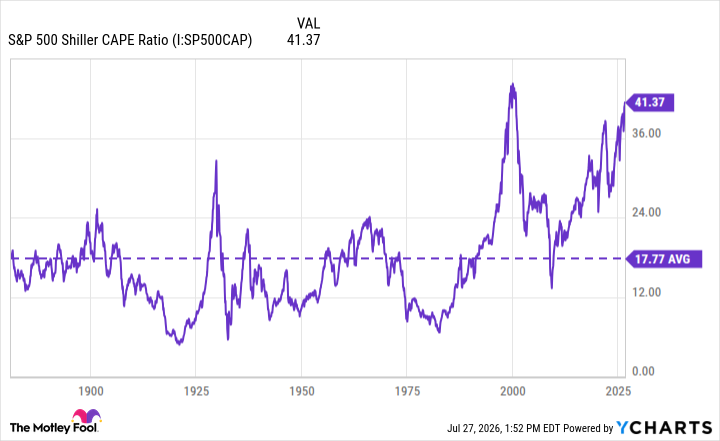
S&P 500 Shiller CAPE Ratio data by YCharts
History shows that when the CAPE ratio peaks, the market rarely follows with smooth sailing. Periods of elevated CAPE readings typically produce below-average returns over the subsequent years — often in the low single digits or even negative as valuations slowly revert to the mean.
How can investors prepare for a bear market?
Preparing for a potential drawdown, recession, or outright bear market does not require a complete portfolio overhaul or frequent trading. The most durable defense begins with owning blue chip companies whose balance sheets, competitive positions, and cash flow generation have been battle-tested across multiple economic cycles. Maintaining deliberate cash reserves provides both psychological comfort and the financial flexibility to rebalance or add to positions when prices become more favorable.
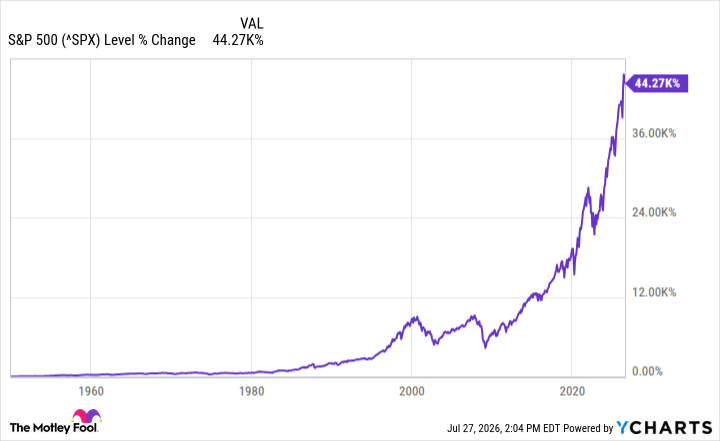
History demonstrates that the S&P 500 always emerges higher after every period of digestion, whether the declines last months or several years. Against this backdrop, the single most important action remains the simplest: Stay the course.
Time in the market consistently rewards those who resist the urge to abandon their portfolio at the moments of greatest discomfort. By investing in quality companies and supplementing sensible diversification with ample liquidity, investors will be positioned to endure temporary setbacks.
With this portfolio structure and long-term mindset, disciplined investors remain positioned to participate fully in any recovery that has, without exception, followed every previous bear market.