
Amazon.com (NASDAQ: AMZN) is in talks over a Decart acquisition that could value the artificial intelligence startup at roughly $7bn, the Wall Street Journal reported on 11 October 2026.
The figure, cited by people familiar with the matter, was independently reported by Reuters. No agreement has been signed, and the talks could still collapse or draw another bidder.
What Decart does for Amazon
Decart builds software that lets developers move AI workloads between different types of chips, a capability Amazon Web Services has watched closely as it pushes its own Trainium silicon against Nvidia Corp (NASDAQ: NVDA) processors. AWS gave Decart early access to its Trainium3 chip in 2025.
The startup, founded in 2023 by Israeli engineers Dean Leitersdorf, Orian Leitersdorf and Moshe Shalev, has built two flagship models: Lucy, which edits live video in real time, and Oasis, which generates simulated environments used to train robotics and autonomous-driving systems, according to reporting carried by StreetInsider.
A rival bidder walked away first
Decart raised $300m in May 2026 in a round led by Radical Ventures, with Nvidia Ventures also participating, valuing the company at nearly $4bn and taking its total funding above $400m, according to SiliconANGLE. Its backers also include Adobe Ventures, Sequoia Capital and Benchmark.
Anthropic explored buying Decart for around $6bn in August 2026 and walked away in September after due diligence, according to Bloomberg reporting carried via Reuters and StreetInsider. Amazon is itself a major investor in Anthropic, which makes its own run at a target its stakeholder passed on a notable wrinkle in the deal’s backstory.
Amazon’s balance sheet and the wider market backdrop
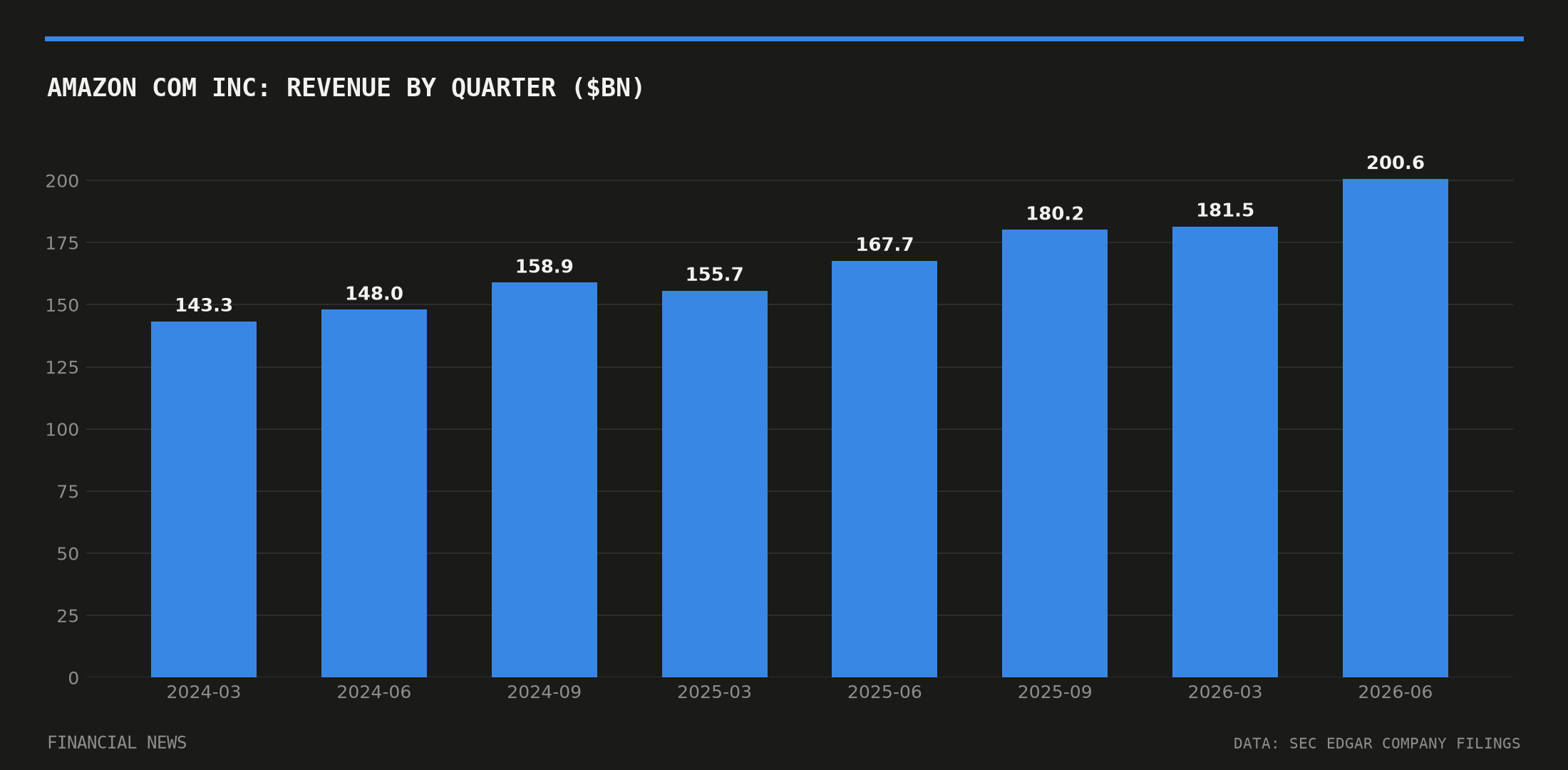
A $7bn purchase would be small relative to Amazon’s scale. The company reported net income of $62.647bn for the quarter to 30 June 2026, filed in its 10-Q with the SEC. Quarterly revenue has climbed steadily through the AI build-out, from $155.667bn in the first quarter of 2025 to $200.606bn in the second quarter of 2026, filings show. Diluted earnings per share for the latest quarter stood at $5.75, up from $2.78 three months earlier, according to the same filing.
That growth trajectory has tracked a broader run of improving results: net income rose from $10.431bn in the first quarter of 2024 to $21.187bn by the third quarter of 2025, before accelerating further into 2026, based on figures disclosed across Amazon’s quarterly filings with the SEC. The pattern underscores why dealmakers see Amazon as a buyer with ample firepower for bolt-on AI acquisitions, even at startup valuations that have roughly doubled in under six months.
Dealmaking of this kind is unfolding against a backdrop of still-elevated borrowing costs. The 10-year US Treasury yield stood at 5.22% on 8 October 2026, down slightly from 5.28% a week earlier, according to data from the Federal Reserve Bank of St Louis. The 2-year yield sat at 4.75%, with the gap between the two narrowing marginally to 0.44 percentage points, Fed data show. Higher-for-longer rates have not stopped large technology groups from paying up for AI capability, though they do raise the opportunity cost of cash deployed on acquisitions rather than returned to shareholders or reinvested in infrastructure such as Trainium.
What happens next
Amazon has not confirmed the talks, and the Journal’s sourcing leaves open the possibility the deal does not proceed. SiliconANGLE’s reporting notes the company’s interest sits alongside Amazon’s broader push to court AI developers toward Trainium as an alternative to Nvidia hardware, a contest in which chip-switching tools such as Decart’s carry strategic weight beyond their immediate price tag. Investors will be watching for confirmation of definitive terms, or a collapse of talks similar to the one Anthropic walked away from in September.
This article is for information only and is not investment advice or a recommendation to buy or sell any asset. Markets move quickly; figures are correct as sourced at the time of writing. Always do your own research before making financial decisions.